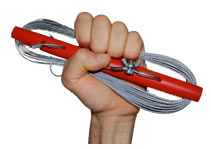
Learn how to cut a
snow cornice using the BackcountryBomb tool
Snow cornice cutting just got a lot easier using the BackcountryBomb
tool! Backcountry skiers and snowboarders, snow avalanche forecasters,
professional ski guides and heli-ski guides, and professional ski
patrol have been cutting and dropping cornices for a long time
in the backcountry, now, with the BackcountryBomb tool they are
able to drop an icy, dense snow cornice with more efficiency than
before.
It's as good as snow cornice cutting gets without explosives!
Cornice cutting basics using the BackcountryBomb tool (one-person
method):
Start small. Practice cutting smaller cornices
before moving on to larger ones with more severe consequences.
Look below. NEVER (absolutely crucial!) Never perform a snow cornice test if you think there may be other travelers below or you can't see 30 degrees in either direction of the fall line, dropped cornices have unpredictable paths down slope and may produce very large avalanches.
Rope up. Cornices commonly
break off farther back from where you think they will and can
break at anytime unexpectedly. Approach the cornice attempting
to remain on solid ground if possible, if not, remain as far
back from the cornice as possible.
Poke around. Use your avalanche
probe pole to poke around through cornices to find the edge of
solid ground and to locate hidden rocks, branches, or other buried
treasures that wire cable may become hooked on.
Clip it. Uncoil the wire cable
and clip one end of the wire cable to your extended avalanche
probe. Watch our BackcountryBomb
instructional video for the
recommended way to coil and uncoil the wire cable for best
use and to avoid unwanted cable twists and kinks. You should
now be holding a BackcountryBomb handle in one hand and the
avalanche probe in the other hand.
Whip it. Keeping the wire
cable in front of you, use a casting motion and attempt to
whip the BackcountryBomb wire cable around the cornice to effectively
"lasso" it. It is helpful if your ski partner is standing on
solid ground in a position to see the entire cornice, your
ski partner can help to verbally guide you into situating the
wire cable around the cornice allowing you to remain farther
back from the cornice.
Snip it. Once the wire cable
is in place around the cornice, bring the avalanche probe back
to you and unclip the probe to retrieve the other handle. Now,
you are holding a handle in each hand and no part of the tool
is behind you or wrapped around a body part (keep your hands
on the handles, never on the cable or inside a cable loop). Then,
keep a hold of the handles and walk backwards or sideways away
from the cornice using a sawing motion to cut the cornice at
the steepest angle possible.
Tips for using the BackcountryBomb tool
The Rub n' Tug - Be aware, dense cornices may
unexpectedly tug on the wire cable while dropping, this is normal,
keep a firm grip on the handles (never put hands on the wire cable
or inside wire cable loops), if the force is too great, let go
of the handles.
The Human Backcountry Bomb - Be sure to avoid
becoming a human backcountry bomb by never allowing the wire cable
or any part of the BackcountryBomb tool to be behind you.
The Snag - If the wire cable becomes stuck, stop to avoid fraying the wire cable. Then, if possible, try changing directions on the cut, it may be that you're caught in ice/rock and changing directions will release the wire. If all else fails, use the wing nut release to remove a handle allowing you to pull the wire cable through the cornice (don't try to pull a handle through the cornice.) Re-assemble and try again. Hint: a leatherman type tool helps!
The Fray - If you regularly have to remove the handle, over time, the cable will fray and it will become impossible to thread the cable back thorough the nylon sleeve and handle. To repair the frayed cable end, simply clip off an inch or two of the frayed end and carefully feed it back through the nylon sleeve and handle, then, tighten the wing nut on the releasable bolt and tape off the end with duct tape (or similar).
More, Bigger, Better - In an attempt to have one large release as opposed to having several smaller premature releases, try cutting 1/3 of the cornice in one direction and then, change directions to cut the rest of the cornice. This tactic is especially helpful when cutting non-overhung cornices.